Decorative Book Elements with Closed an
A Vintage-Inspired Embroidery Design That Feels Like a Thoughtful Gift—Before You Even Stitch It
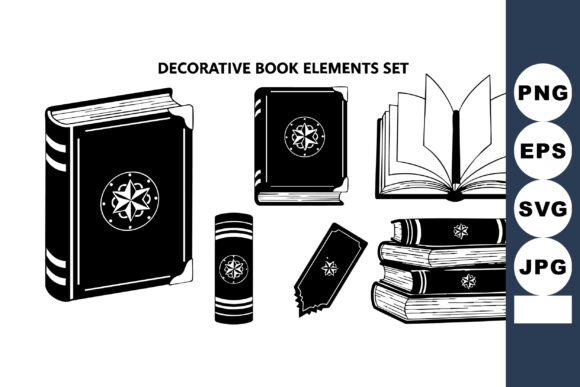
I pulled up Decorative Book Elements with Closed an last week while prepping a custom embroidered tote for a local indie bookstore’s holiday pop-up. The client wanted something timeless—not cutesy, not trendy—just warm, literary, and quietly confident. That’s exactly what this illustration delivers at first glance: three closed books stacked with gentle shadow, one open book showing delicate page lines, and a slender vintage bookmark curling just so. No text, no clutter. Just elegant negative space, balanced weight, and that unmistakable “well-read” calm.
This isn’t a busy clipart bundle—it’s a cohesive Illustrations set built for intention. As a designer who’s stitched hundreds of book-themed pieces (baby onesies, teacher appreciation gifts, library volunteer aprons), I immediately saw how Decorative Book Elements with Closed an avoids the common pitfalls: no overly tight corners that’ll pucker on cotton twill, no micro-details that vanish in fill stitch, and no forced symmetry that feels sterile. It breathes. And in embroidery, breathing space is where clarity lives.
Where It Shines—and Where You’ll Want to Pause
I tested it on a medium-weight canvas tote first—standard 4” hoop, tear-away + cut-away stabilizer combo, standard 40-weight rayon. The open book held its shape beautifully; the spine lines read clearly without over-stitching. The bookmark’s curve translated smoothly into satin stitch, and the closed books’ subtle highlights added dimension without demanding extra color changes. For custom apparel, think sweatshirt chest logos or left-chest embroidery on linen shirts—this design reads cleanly at 3.5” wide, and scales gracefully down to 2.75” for baby embroidery on a onesie front.
It also works exceptionally well as an embroidered patch. I digitized a version with clean edge binding and used it on a denim jacket sleeve—customers paused mid-browse to ask where I got the “old library charm.” That’s the quiet power of Decorative Book Elements with Closed an: it invites attention without shouting. It feels handmade, not machine-made—even when it is.
But here’s where realism matters: this design assumes a baseline of control. On stretchy fabric like lightweight knits or ribbed baby caps, I’d reduce stitch density slightly and add a light fusible backing before hooping. The open book’s inner page lines are graceful, but they’re narrow—under 1.2mm at their thinnest—so they’ll blur on textured fabrics like bouclé or heavy terry cloth unless you stabilize aggressively. And while it’s lovely on dark fabric, avoid deep navy or charcoal unless you test thread contrast first: cream or antique white thread lifts the vintage mood, but can disappear against black without a subtle underlay.
Real Projects, Real Reactions
Last month, I used Decorative Book Elements with Closed an on a set of kitchen tea towels for a small shop launch. Paired with simple serif embroidery text (“Read Slowly”), it became a bestseller—not because it’s flashy, but because customers *recognized* it. They saw themselves: the reader, the teacher, the parent tucking a storybook into a toddler’s backpack. That recognition is gold for Etsy sellers and small shop products. It doesn’t need explanation. It lands.
I’ve also layered it into printable mockups for digital product previews—using flat vector versions from the ZIP—and found it holds up across formats: social banners, product tags, even packaging stickers. That versatility makes it more than a single-use digital embroidery file; it’s a flexible design asset for branding consistency across physical and digital touchpoints.
What This Design Says About Your Craft—and Your Customers
Using Decorative Book Elements with Closed an subtly signals care. Not just in execution—though proper stabilizer choice and thoughtful thread colors matter—but in curation. It tells your buyer you value restraint, elegance, and narrative over noise. That builds customer trust, especially for personalized gifts like graduation keepsakes or librarian retirement presents. People don’t buy book graphics—they buy the feeling of being seen as thoughtful, curious, grounded.
For commercial embroidery work, it performs reliably across project types: nursery decor pillows (scaled to 4.5”), holiday gift tags (as a 1.5” corner accent), even boutique-branded aprons for indie book cafés. Its educational mood is inclusive—not academic, not childish—just warmly intelligent. That’s rare.
Practical Designer Notes Before You Stitch
- Always test on scrap fabric first—especially if using textured or dark materials.
- Review stitch density in the open book’s interior; adjust if your machine struggles with fine detail.
- Confirm hoop size compatibility—this layout fits comfortably in a 5” x 7”, but check the actual file dimensions before scaling.
- Inspect small details like the bookmark’s tip and spine creases in both black-and-white and color mockups.
- Compare performance on light vs. dark backgrounds—some vintage palettes lose warmth on black.
- Use appropriate stabilizer: cut-away for knits, tear-away for stable wovens, and optional topping for napped fabrics.
- Verify licensing terms before selling finished items or bundling into digital products—Decorative Book Elements with Closed an is listed as a Graphics download, but commercial rights aren’t specified in the description.
In short: Decorative Book Elements with Closed an earns its place in your working library—not as filler, but as a go-to for moments when elegance matters more than volume. It’s the kind of machine embroidery design that makes clients say, “Yes—that’s exactly what I imagined,” even when they couldn’t quite name it. And in a crowded craft market, that quiet resonance? That’s the real stitch that holds.